It happens to the best of us.
You spend three weekends in the garage building a beautiful farmhouse dining table. The joints are tight, the sanding is flawless, and that final coat of polyurethane looks like glass. You bring it inside, the family loves it, and you feel that deep sense of pride.
Six months later, winter hits. The heater turns on. The air gets dry. And suddenly, you hear a loud pop from the dining room.
You walk in to find a hairline crack running right down the middle of that beautiful tabletop. Or maybe the breadboard ends you painstakingly attached have pushed the miter joints apart at the corners.
What happened? You didn’t use bad wood. You didn’t use bad glue.
You just forgot the golden rule of carpentry: Wood is alive.
Understanding the “Sponge” Effect
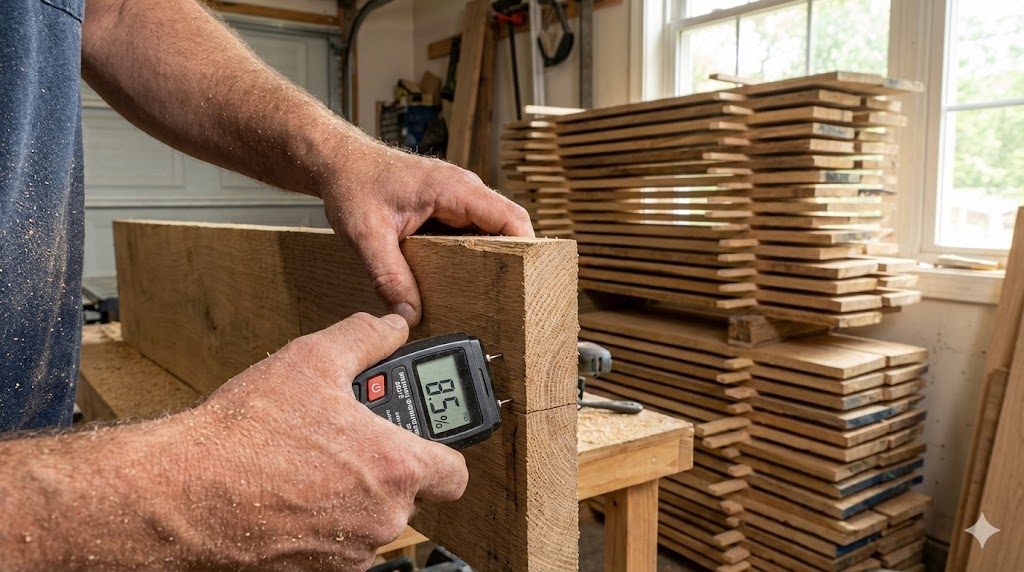
Even years after it was felled, chopped, and kiln-dried, wood never really dies. It is hygroscopic, which is a fancy way of saying it acts like a stiff sponge.
When the humidity is high (like in summer), wood fibers absorb moisture from the air and expand across the grain. When the air dries out (like in winter when the furnace is running), that moisture evaporates, and the wood shrinks.
A 30-inch wide oak tabletop can easily expand and contract by a full quarter-inch throughout the year.
If you build a project and “lock” that wood in place so it cannot move—by gluing pieces with opposing grain directions or screwing a tabletop firmly to an apron—something has to give. The wood will always win. It will crack itself to relieve the tension.
How to Build for Movement
You cannot stop wood from moving. The secret to long-lasting furniture is to build around the movement. Here are three rules every “Woodwork Weekly” reader should live by:
1. Acclimate Your Lumber Don’t buy wood from a cold lumber yard on Saturday morning and start cutting it Saturday afternoon. Bring it into your shop (or wherever the final piece will live) and let it sit for at least a week. Let it adjust to the environment before you make your first cut.
2. Beware of Cross-Grain Glue ups Wood moves significantly across its width (tangential), but very little along its length (longitudinal).
The classic mistake is gluing a “breadboard end” (a board running perpendicular) onto the end of a tabletop. You are gluing a piece that wants to stay stable onto a piece that desperately wants to shrink. This is guaranteed to fail. Never glue cross-grain joints unless they are very small.
3. Use the Right Fasteners When attaching a tabletop to a base, never just drive screws straight up through the apron into the top. You’ve just handcuffed the wood.
Instead, use methods that allow for “float.” Figure-eight fasteners, Z-clips, or simply drilling elongated, oval-shaped screw holes in your apron will allow the screw to slide back and forth as the top expands and contracts.
The Bottom Line Building beautiful things isn’t just about making straight cuts. It’s about understanding your material. Respect the wood, give it room to breathe, and your projects will last for generations, not just seasons.